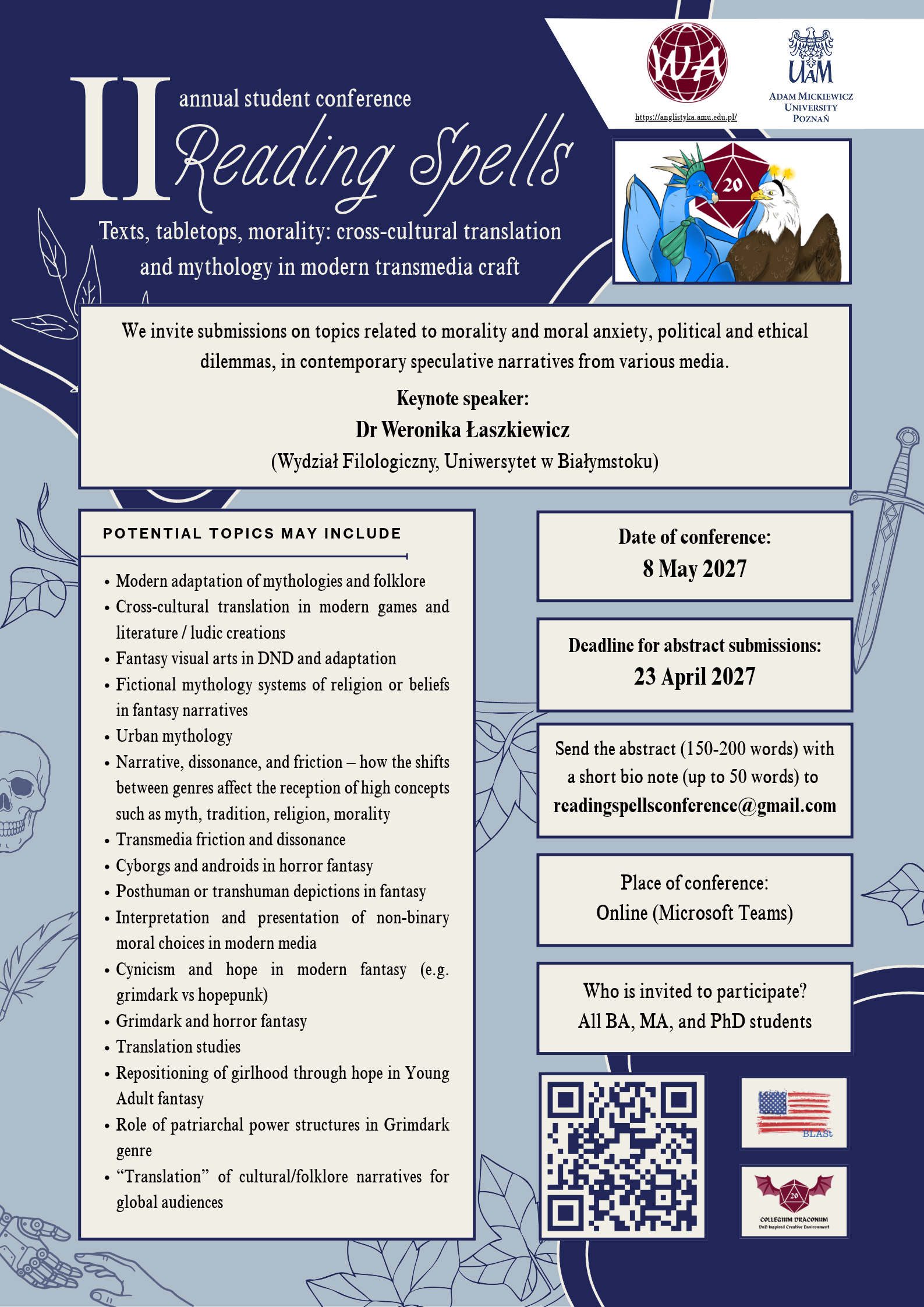
Reading Spells (second annual student conference): Texts, tabletops, morality: cross-cultural translation and mythology in modern transmedia craft
Reading Spells (second annual student conference): Texts, tabletops, morality: cross-cultural translation and mythology in modern transmedia craft
Published:
What is the role of morality in today's speculative narratives? What might they offer when faced with paradoxical contradictions of our times? Participants of Reading Spells are welcome to consider questions such as: „how is fantasy portraying morality?”, „how can speculative fiction translate one set of norms for the globalized audience?”, „how is speculative writing imitating, commenting on, or reinforcing the culture of today?”. We invite submissions on topics related to morality and moral anxiety, political and ethical dilemmas, in contemporary speculative narratives from various media.
Second annual student conference
Reading Spells
Texts, tabletops, morality: cross-cultural translation and mythology in modern transmedia craft
Keynote speaker:
Dr Weronika Łaszkiewicz (Wydział Filologiczny, Uniwersytet w Białymstoku)
What is the role of morality in today’s speculative narratives? What might they offer when faced with paradoxical contradictions of our times? AI and transhumanism, deepfakes and slop, schizoposting and rage storms, radical hope and activism, passivity and resignation… Can our fictional imaginings keep up with such a change in media, in media feeds, in media trends, when we – the intended users, are on the verge of endurance?
It would seem that speculative media and speculative fiction are often themed around concepts such as sanity, morality, hope, and their dark opposites. The second edition of Reading Spells aims to broaden this discussion through the inclusion of cross-cultural translation studies and religious studies, in hopes that it might uncover more about „how” contemporary fiction approaches the aforementioned ideas. Participants are welcome to consider questions such as: „how is fantasy portraying morality?”, „how can speculative fiction translate one set of norms for the globalized audience?”, „how is speculative writing imitating, commenting on, or reinforcing the culture of today?”.
We invite submissions on topics related to morality and moral anxiety, political and ethical dilemmas, in contemporary speculative narratives from various media.
Potential references:
Cohen, Jeffrey Jerome. 1996. Monster Theory: Reading Culture. Minneapolis: University of Minnesota Press.
Huberman, Jennifer. 2021. Transhumanism: From ancestors to avatars. New York: Cambridge University Press.
Nayar, Pramod K. 2014. Posthumanism. Cambridge: Polity Press.
Rowland, Alexandra. 2019. “One Atom of Justice, One Molecule of Mercy, and the Empire of Unsheathed Knives”, The Stellar Beacon – https://festive.ninja/one-atom-of-justice-one-molecule-of-mercy-and-the-empire-of-unsheathed-knives-alexandra-rowland/
Tolkien, J. R. R. [1947] 2008. “On Fairy-stories” in: Verlyn Flieger and Douglas A. Anderson (ed.). 2008. Tolkien On Fairy-stories: Expanded Edition, with Commentary and Notes. London: HarperCollins Publishers.
Potential topics may include:
- Modern adaptation of mythologies and folklore
- Cross-cultural translation in modern games and literature / ludic creations
- Fantasy visual arts in DND and adaptation
- Fictional mythology systems of religion or beliefs in fantasy narratives
- Urban mythology
- Narrative, dissonance, and friction – how the shifts between genres affect the reception of high concepts such as myth, tradition, religion, morality
- Transmedia friction and dissonance
- Cyborgs and androids in horror fantasy
- Posthuman or transhuman depictions in fantasy
- Interpretation and presentation of non-binary moral choices in modern media
- Cynicism and hope in modern fantasy (e.g. grimdark vs hopepunk)
- Grimdark and horror fantasy
- Translation studies
- Repositioning of girlhood through hope in Young Adult fantasy
- Role of patriarchal power structures in Grimdark genre
- “Translation” of cultural/folklore narratives for global audiences
Submission deadline:
April 23rd, 2027
Conference date:
May 8th, 2027
The abstracts can be submitted individually or in pairs.
Send the abstract (150-200 words) with a short bio note (up to 50 words) to readingspellsconference@gmail.com
Place:
Online (Microsoft Teams)
Participants:
The conference is open to all BA, MA, and PhD students as active or passive participants. Every active participant will receive a certificate (including the organisers).
Conference committee:
Head of the committee: prof. UAM dr hab. Paweł Stachura
Secretaries of the committee: Marta Koprucka, Jakub Jach
Committee members: Mikołaj Umerle, Klara Bajor
Reading Spells was created in cooperation between two UAM student research groups: Book Lovers Among Students (BLASt) and Collegium Draconum.
For more details, visit our Facebook page, Reading Spells, at https://www.facebook.com/profile.php?id=61584479400979
or our Instagram pages:
@blast.wa
@collegium_draconum